
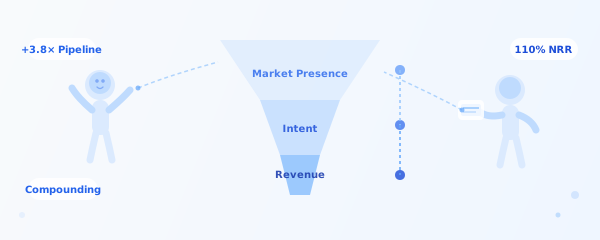
Marketing, as practiced in most B2B companies, is a collection of activities mistaken for a system. You run campaigns. You generate leads. You measure cost-per-click and open rates and MQL volume. You report to the board. The board asks why pipeline is not growing. You run more campaigns.
The problem is not execution. The problem is the frame. Marketing as a function was designed for a world where buyers had limited information and companies controlled the message. That world no longer exists. Today's B2B buyer has done 60–70% of their evaluation before they speak to a salesperson. They have read the category landscape. They have formed a shortlist. They know what questions to ask and what answers to distrust.
In this environment, doing more marketing is not the answer. Designing revenue is.
The Difference Between Marketing and Revenue Design
Marketing is campaign-centric. Revenue Design is system-centric. The distinction is not semantic — it changes every decision you make about where to invest, what to measure, and who owns commercial outcomes.
A marketing team asks: what campaign should we run this quarter? A Revenue Design function asks: what is the system that converts our market position into predictable, compounding revenue — and what are the constraints that are preventing it from performing at its potential?
Marketing measures activity: impressions, clicks, MQLs, content downloads. Revenue Design measures conversion architecture: the rate at which market awareness converts to qualified intent, qualified intent converts to pipeline, pipeline converts to closed revenue, and closed revenue converts to expansion and referral. Every metric exists in relationship to the others, and the system is only as strong as its weakest conversion point.
The Four Stages of the Revenue System
A complete Revenue Design covers four stages, each with distinct inputs, conversion mechanisms, and outputs. Most companies have invested heavily in Stage One and almost nothing in Stages Three and Four — which is why their revenue growth is expensive and fragile.
Stage One — Market Presence: The sum of signals that make your target buyer aware that you exist and believe that you are worth paying attention to. This includes content, SEO, events, analyst relations, awards, PR, and thought leadership. The goal is not awareness as an end — it is category authority: becoming the firm that sophisticated buyers associate with the specific problem you solve.
Stage Two — Intent Conversion: The architecture that converts market presence into qualified pipeline. This is where most marketing functions focus — but they focus on volume rather than quality. A Revenue Design approach optimizes for the conversion rate of the right buyer profiles, not the volume of all profiles. High-quality intent conversion means a shorter sales cycle, a higher close rate, and a lower cost-per-acquired-client.
Stage Three — Revenue Delivery: The operational capability to deliver the outcome your sales process promises. This is almost never considered a marketing function — but it is a revenue function, because poor delivery destroys the compounding dynamics that make revenue systems powerful. Every client you fail to deliver for is an anti-referral, a churn event, and a damaged reference for the next sales cycle.
Stage Four — Expansion and Referral: The mechanisms that turn satisfied clients into larger clients and referral sources. In B2B, this is the highest-return stage in the revenue system — and the most neglected. Companies that invest systematically in expansion and referral grow their revenue per client year-over-year without proportional sales investment, and they fill their pipeline with pre-qualified buyers who arrive with trust already established.
Why the Campaign Mindset Is Structurally Broken
The campaign mindset is broken for three structural reasons, each of which compounds over time:
- Campaigns are episodic; revenue is continuous. A campaign ends. A revenue system does not. Every time you pause a campaign, you pause its contribution to your revenue. A properly designed revenue system continues to generate pipeline, convert clients, and expand relationships whether or not a campaign is active.
- Campaigns optimize for activity; revenue optimizes for outcomes. The success metrics of a campaign (impressions, clicks, downloads) are inputs to the revenue system, not outputs. Optimizing for inputs without measuring their conversion to outputs is like measuring how many seeds you plant without measuring how many grow.
- Campaigns are additive; revenue systems are compounding. Every campaign you run costs roughly the same to produce its next unit of output. A well-designed revenue system produces increasing returns over time: each piece of category content builds on the last, each client reference makes the next sale easier, each expansion deepens the relationship and makes churn less likely.
The MoatScore™ and Revenue System Health
One of the most useful outputs of a Revenue Design engagement is a MoatScore™ — a composite assessment of how well your current commercial architecture is performing across each stage of the revenue system and each dimension of competitive insulation.
A MoatScore™ is not a vanity metric. It is a diagnostic tool that identifies precisely where your revenue system is losing value. Common patterns we observe:
- High market presence, low intent conversion: The brand is visible but the positioning is not sharp enough to move the right buyers to action.
- High intent, low close rate: The sales process is introducing friction that the positioning has already overcome — usually because the sales narrative does not match the marketing narrative.
- High close rate, high churn: Delivery is mismatched to the promise made in the sales cycle — or the client profile is wrong despite a successful close.
- Low expansion, low referral: There is no systematic mechanism for deepening client relationships or converting satisfaction into advocacy. This is almost always a process gap, not a relationship quality gap.
What Revenue Design Looks Like in Practice
Revenue Design is not a rebrand of the marketing function. It is a restructuring of how commercial outcomes are owned, measured, and improved. In practice, it means:
- Replacing quarterly campaign plans with a 12-month Revenue Architecture that defines the system, not the activities
- Assigning revenue outcome ownership to cross-functional roles — not siloing pipeline in sales and awareness in marketing
- Measuring conversion rates at each stage of the system, not just volume at the top of the funnel
- Investing in retention and expansion infrastructure proportionally to acquisition infrastructure — because in a compounding revenue system, the back half of the client lifecycle is worth more than the front half
- Building proprietary content and thought leadership assets that compound in authority over time rather than expiring with each campaign cycle
The Commercial Imperative
The companies that will dominate their categories over the next decade are not the ones with the biggest marketing budgets. They are the ones that design their commercial systems with the same rigor they apply to their products and operations. They understand that revenue is an outcome of architecture, not activity — and they invest accordingly.
If your current growth motion feels like running faster on a treadmill, the problem is not effort. The problem is that you are still doing marketing when your competitors are designing revenue. The shift in frame is available to you. The question is whether you will make it before they do.
That is the only timing question that matters.

Ready to build compounding market advantage?
Let's design a growth system that your competitors can't replicate. Talk to a MoatSquare strategist today.
Start the Conversation